Boost App Visibility: 11 Tactical ASO Moves That Work Now
Step-by-step playbook to boost app visibility, increase installs, and improve rank. Tactical ASO moves, metrics, and tests you can run now.
By Shoham Lachkar · Published
Introduction
You can boost app visibility predictably if you stop guessing and apply a prioritized, test-driven playbook. This guide gives exact moves, benchmarks, sample test designs, and sample math so you can launch high-impact experiments this week. Read fast, pick three plays, run tests, and measure incremental lift.
How to boost app visibility: where to start and what to measure
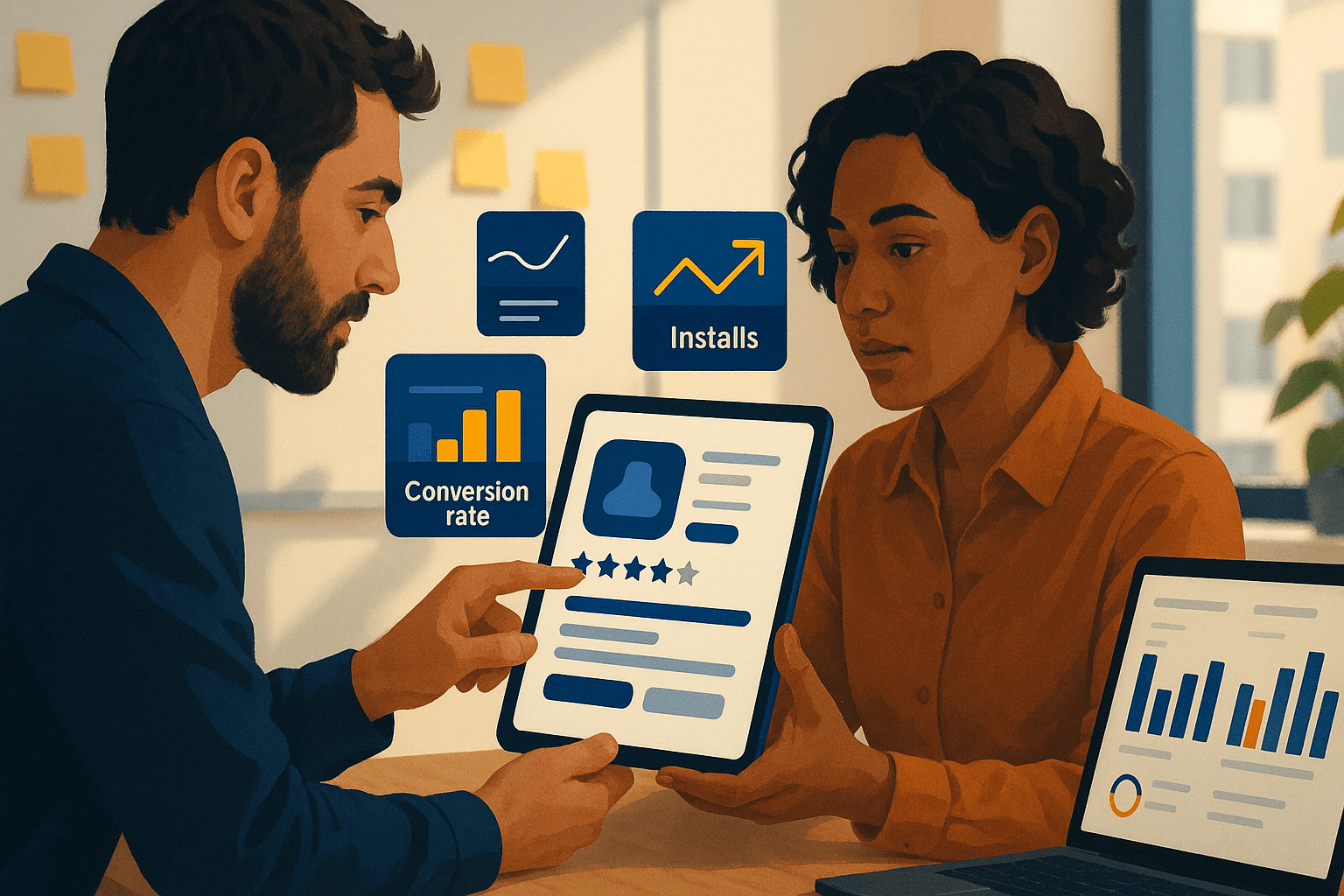
Start by measuring three metrics: impressions, product page views (page views), and store conversion rate (install rate from the product page). Those three drive organic installs and store ranking.
Benchmarks you should know right away:
- Impressions growth target: aim for a 15 to 30 percent increase quarter over quarter through keyword expansion and featured placements.
- Product page CTR (impressions to page views): typical range 2 to 8 percent for search traffic. If you are below 2 percent, your creative or title is missing the intent match.
- Store conversion rate (page views to installs): typical range 20 to 60 percent depending on category. Free apps often sit between 30 and 45 percent.
Set targets per channel. Example targets for a mid-volume app:
- Search impressions +25 percent in 90 days.
- Organic installs +20 percent in 90 days.
- Store CVR lift +10 percent relative.
If you cannot measure impressions by keyword, focus first on page views and CVR until you enable keyword-level analytics with ASO Tools or platform APIs.
Prioritized tactical playbook - 11 ASO moves with impact and effort
Use ICE scoring to prioritize: Impact (1-10), Confidence (1-10), Effort (1-10). ICE = Impact * Confidence / Effort. Aim for quick wins with ICE > 6.
1) Title and subtitle - highest impact
Why: Title is the single strongest signal for organic discoverability and search CTR.
Action:
- Add 1 to 2 high-volume keywords with intent, not stuffing.
- Keep readable copy for users, not just keywords.
Test: change title variant A to include primary feature plus brand, variant B to lead with strongest keyword phrase. Run until statistical significance or 2 weeks.
Typical lift: expect 8 to 20 percent increase in search impressions if you match top intent.
2) Short description / subtitle optimization
Why: Subtitles influence both user decision and keyword indexing on many stores.
Action: test benefits-first copy vs feature-first copy. Use numbers and outcome statements: "Save 30 minutes per week".
3) Icon refresh
Why: Icon affects store CTR more than you think for browse and featured traffic.
Action: run 3-variant icon test: simplified symbol, context-driven icon, and variant with subtle badge.
Expected CVR lift range: 3 to 12 percent per successful icon.
4) Feature graphic / video
Why: Video increases installs by showing the core user flow. Use a 15-30 second clip that starts with the primary value prop in first 3 seconds.
Action: create one control video and two variants that differ in opening hook and pacing. Test on stores that support video.
Typical lift: 10 to 40 percent in conversion for users who watch the preview.
5) Screenshots - narrative and localization
Why: Screenshots are the main persuasion layer on the product page.
Action: lead with the screen that demonstrates the core action. Add a short benefit caption and a clear CTA. Localize both imagery and copy.
Expected lift from localization: 15 to 80 percent in installs from localized markets, depending on baseline.
6) Keyword refresh and expansion
Why: More relevant keywords create more impressions and higher rank for long-tail queries.
Action: run a 30-day keyword harvest: map top competitors, extract keyword overlaps, and add 5 long-tail phrases per week with moderate search volume.
Metric: track keyword impressions and rank. Expect search impressions to increase 10 to 30 percent after three weeks.
7) Ratings and reviews program
Why: Rating changes are correlated with ranking and CVR.
Action: implement an in-app prompt to request reviews after the user's Aha moment. Respond to negative reviews within 48 hours.
Tactical KPI: increase 4-star and 5-star reviews by 20 percent in 60 days. That can improve CVR by up to 8 percent.
8) Localization and market prioritization
Why: Low effort, high return for non-English markets with less competition.
Action: pick two top growth languages, localize title, subtitle, screenshots, and store listing in that order.
Expected ROI: installs can grow 25 to 70 percent in newly localized markets.
9) Off-store signals and web presence
Why: Editorial teams and platform algorithms factor external demand.
Action: publish two technical blog posts, a landing page, and a campaign with referral links. Track uplift in branded search impressions.
10) Editorial and feature outreach
Why: Being featured multiplies impressions by 5 to 20x.
Action: craft a short pitch focused on a unique hook, data, or local angle. Measure editorial uplift separately to avoid confounding tests.
11) Store experiments and A/B testing cadence
Why: Systematic experiments build repeatable growth.
Action: run one hypothesis-driven experiment per week on creative variants, and one keyword experiment per month. Keep a test log with hypothesis, duration, and result.
Creative testing plan and exact experiment design
A hypothesis example: "Replacing the first screenshot with an onboarding screen will increase page-to-install conversion by 10 percent among organic users."
Experiment design steps:
- Define metric and audience: primary metric = store conversion rate; audience = organic search traffic only.
- Baseline: measure last 28 days conversion and sample size.
- Minimum detectable effect (MDE): set at 10 percent relative lift.
- Statistical plan: 95 percent confidence, two-tailed test.
- Run time: at least one full weekly cycle and until sample size met.
- Analyze results and follow-up: if positive and p < 0.05, roll out; if negative, iterate.
Sample size math (practical):
Use this quick formula for binary conversion tests. For baseline conversion p, and absolute difference d you want to detect, sample per variant is approx:
n = (Z^2 * p * (1 - p)) / d^2
Where Z = 1.96 for 95 percent confidence. Example: baseline conversion p = 0.30, we want to detect a 10 percent relative lift which is 0.03 absolute (d = 0.03). Then n = (3.8416 * 0.21) / 0.0009 = 0.8067 / 0.0009 = 896. So you need about 900 conversions per variant. If your conversion event is installs, compute required page views by dividing by baseline conversion.
Always check both conversion counts and page view counts. If you lack volume, test creatives on paid channels to get quicker signal, then roll organic.
How to read results and avoid common mistakes
Mistake 1: measuring combined traffic. Always segment by traffic source. Search, browse, and featured audiences behave differently.
Mistake 2: running multiple changes at once. If you change title and icon together, you break attribution. Split changes across sequential experiments.
Mistake 3: stopping tests too early. Short runs increase false positives. Use the sample size guidance above.
Signal to watch beyond p-values:
- Consistent lift across 3+ days and time-of-day segments.
- Movement in keyword impressions or rank when testing metadata.
- User retention and first-week engagement for acquisition experiments - a CVR lift that causes lower retention can be negative overall.
Example case study you can replicate
A meditation app used this sequence and saw organic installs rise 37 percent in 8 weeks.
- Keyword audit and title change. Matched two high-intent long-tail keywords. This increased search impressions 28 percent in three weeks.
- New onboarding screenshot and short video focusing on quick wins. Page-to-install CVR increased 18 percent after the creative test.
- Localized store copy and screenshots for Spanish and Portuguese markets. Local installs rose 62 percent in those markets.
Total outcome: organic installs +37 percent, store CVR +12 percent, average session length +9 percent.
Tools and cross-team process
You need the right tools and rhythm. Use an ASO platform for keyword tracking and experiment management. Combine that with product analytics for retention tracking.
Internal process:
- Weekly ASO standup to review experiment cadence and status.
- Monthly keyword review tied to content calendar.
- Quarterly localization sprint.
If you want a short reading list, start with Learn about ASO for fundamentals, and read Creative Optimization for how to design screenshot and video tests. Use ASO Tools to automate rank and impression tracking. For algorithm-level behavior read OS Algorithm to understand ranking drivers.
Prioritization checklist you can run this week
- Audit title and subtitle for intent match. Add 1 high-value keyword. ICE score check.
- Run a 3-variant icon test with equal traffic splits.
- Create a 15-second video focusing on the first 3 seconds as a hook. Test against control.
- Implement in-app review prompt at key user milestone.
- Pick one market and localize screenshots and listing copy.
If you have limited engineering support, prioritize copy and creatives first. They deliver the highest ROI per hour.
Closing: start the tests that matter
Boosting app visibility requires a mix of keyword work, creative testing, and measurement discipline. Use the ICE framework to pick the best experiments. Track impressions, page views, and conversion with clear segmentation. If you want a fast starting point, run our free audit to see which three moves will likely give you the biggest lift for your app.
Get a free audit at /#audit and create an account at /signup to track experiments and results in one place. Appeak Pro automates the analysis and gives test templates you can run immediately.
Frequently asked questions
How long before I see results from ASO changes?
You can see early signals in 1 to 2 weeks for creative tests and 2 to 6 weeks for keyword and ranking changes. Editorial or featured placement impacts appear immediately but are less predictable. Always run tests until the required sample size is reached and segment results by traffic source.
Which change gives the fastest lift in visibility?
Title and subtitle tweaks plus an icon refresh typically give the fastest measurable lift in impressions and CTR. Those are high-impact, low-effort changes you can test first.
What if my traffic volume is too low for A/B testing?
If organic volume is low, test creatives on paid channels to validate direction. You can also run sequential single-variant tests or focus on localization to markets with higher volume. Use the sample size math in the article to plan feasible MDEs.
How should I prioritize keywords?
Prioritize by intent, search volume, difficulty, and relevance. Target long-tail intent phrases with moderate competition first. Use a scoring matrix: Impact = volume * relevance, Effort = change needed, Confidence = data support.
Side by side
Manual experiment cycle vs Appeak Pro
The traditional growth loop, research, write, ship, measure, iterate, works, but takes weeks per cycle and is bounded by team capacity. Appeak Pro generates the metadata + creative direction part of that cycle automatically.
In-house manual cycle
- Cost
- PM + designer + analyst time
- Cycle time
- Weeks per cycle
- What you get
- Bounded by team capacity
Agency-run cycle
- Cost
- $5,000-$15,000 / month
- Cycle time
- Weeks per cycle
- What you get
- Faster, but per-market cost
Appeak Pro
- Cost
- Flat per audit
- Cycle time
- Minutes
- What you get
- Same scored keyword bank + metadata + creative direction, automated
Appeak Pro produces the keyword bank, metadata rewrite, and creative direction described in this playbook, automatically, in your free audit.