Improve App Store Ranking: 6 Tactical Levers to Boost Installs
Practical steps to improve app store ranking, boost organic installs, and increase impressions with tests and metrics you can run today.
By Shoham Lachkar · Published
You will improve app store ranking by moving three numbers: impressions, page conversion rate, and retention. This guide gives a short, prioritized playbook with six tactical levers, exact tests to run, and how to read results. If you want quick impact, start with creative tests and metadata refinement in parallel.
How to improve app store ranking: the 6 tactical levers
These levers change the signals the store algorithm and humans use to rank your app. Work them in parallel, not one at a time. Prioritize based on your current weakest metric.
- Keyword and metadata optimization
- Creative optimization for conversion rate
- Increase impressions - traffic and discoverability
- Improve first-day retention and engagement
- Technical and compliance fixes
- Measurement and experiment discipline
Each lever below includes what to change, exactly how to test it, and thresholds for success.
1) Keyword and metadata optimization
What to change
- Title and subtitle: include 1-2 high-volume, relevant keywords. Keep readability high. On Google Play, use long, natural descriptions; on iOS focus the subtitle and keyword field.
- Keyword field (iOS): prioritize top 10 keywords by search volume and relevancy.
- Short description / promotional text (Play): include 2-3 target keywords early.
- Localize: translate metadata for top 5 markets you treat as growth regions.
How to test
- Run a sequential AB test: change metadata for one locale only, then measure search impressions and organic installs for that locale compared to a control locale. Expect algorithm effects to appear in 1-3 weeks.
- Track keyword rank weekly in your ASO tool and monitor impressions increase. Use rank change plus impressions as the success signal, not rank alone.
Success thresholds and example
- If current organic search impressions are 10,000/month, a good metadata test should deliver a 10-30% lift in impressions in 3-6 weeks. Smaller lifts are real but harder to detect statistically.
- Example: Moving a high-volume keyword into the subtitle increased Play search impressions from 12k to 16k in 4 weeks - a 33% lift, which translated to +18% organic installs once creatives were optimized.
2) Creative optimization for conversion rate
What to change
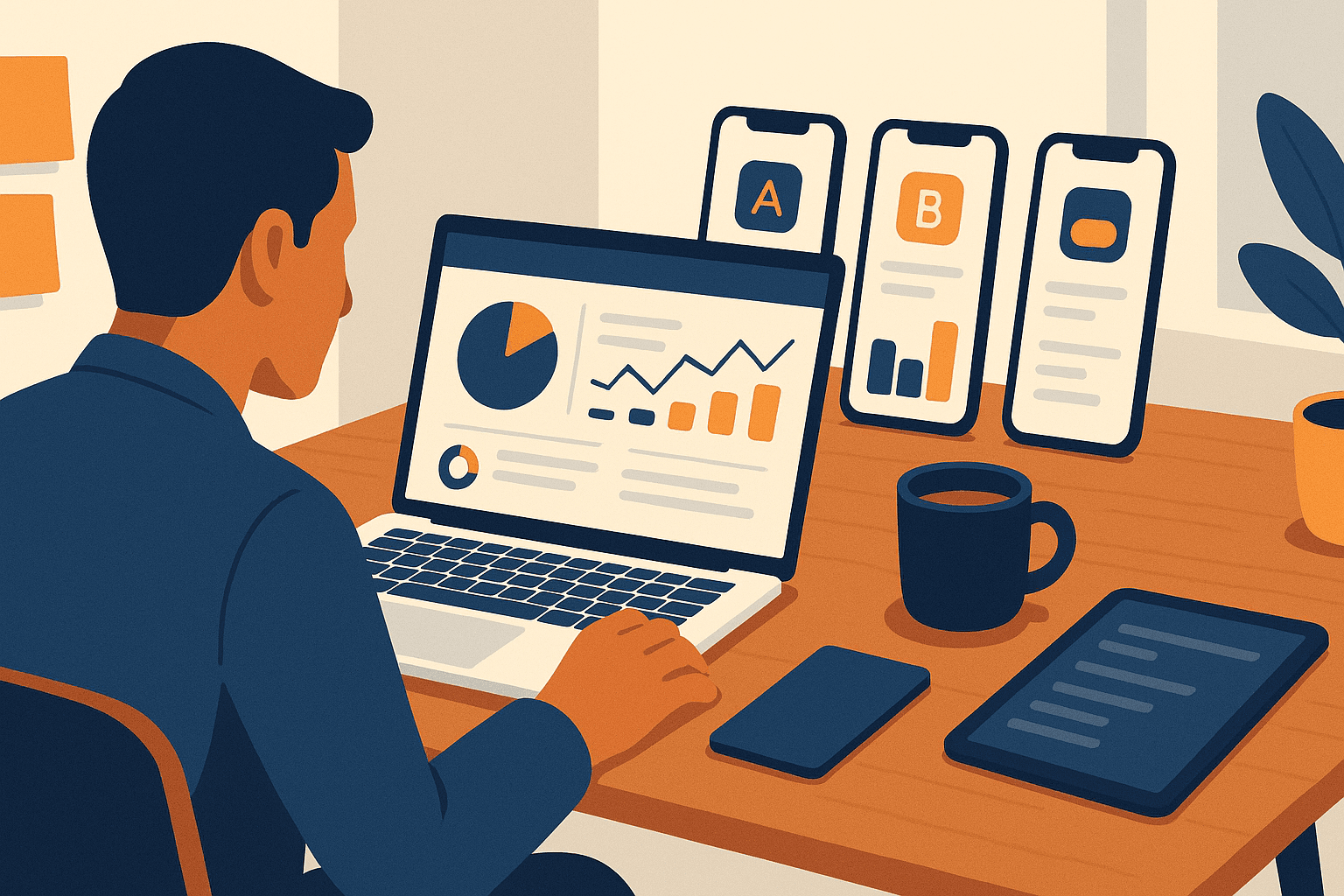
- Icon, first two screenshots, and the app preview video. These control page conversion rate from view to install.
- Test clear value proposition in the first screenshot. Use short overlay text that states the main benefit - on Play use Google Play experiments.
- For iOS, run product page A/B tests with alternate screenshots and videos.
How to test
- Run multivariate tests only if you have enough traffic. Start with single-variable A/B tests: icon first, then screenshots, then video.
- Minimum sample: use the sample size calculator below. As a rule of thumb, for a baseline conversion rate of 25% and a desired relative lift of 10% (absolute change to 27.5%), you need ~40,000 views per variant for 95% confidence. If you have less traffic, aim for larger effect sizes or run sequential tests and wait longer.
Concrete benchmarks
- Good conversion rates by category vary. As a rough baseline: casual games 15-25% CVR, utility apps 25-40% CVR, subscription services 18-30% CVR. Your aim: a 10-25% relative lift per design improvement.
Quick creative checklist
- Icon: single concept, high contrast, 1.5x larger elements for small thumbnails.
- First screenshot: headline + one key benefit, avoid clutter.
- Video: 15 seconds, silent-first 3 seconds show core value, no text-only intros.
3) Increase impressions - traffic and discoverability
What to change
- Keyword reach: expand to long-tail phrases and localized terms.
- Off-store channels: press, SEO landing pages, YouTube gameplay or demo videos, social micro-influencers. Each external link and traffic spike increases store signals.
- Paid campaigns for targeted keywords only when running creative experiments - use paid traffic to seed relevance and collect faster test data.
How to test
- Run targeted UA campaigns to a specific geo and measure lift in organic ranking for target keywords. Run campaigns for 2-4 weeks and compare to a matched control geo.
- Use uplift analysis: track keyword impressions and ranking before, during, and after campaign. If ranking and impressions stay elevated after paid stops, algorithm signal likely updated.
Benchmarks
- To see algorithmic ranking changes for a keyword, expect 1-6 weeks depending on store and category competition.
- Small campaigns: 500-2,000 installs concentrated on 1-2 keywords can move explore-level rankings in mid-tier categories.
4) Improve first-day retention and engagement
What to change
- First session flow: reduce friction, remove lengthy sign-ups, add lightweight guided tour or benefits carousel.
- Tactical push notifications and onboarding emails in the first 24-72 hours.
- Fix major crash and ANR issues; stores penalize apps with poor stability.
How to test
- A/B test onboarding flows internally using feature flags and measure D1 and D7 retention.
- If you cannot A/B in-app, use phased rollout and cohort analysis.
Thresholds
- A 3-5 percentage point lift in D1 retention for a mainstream app is meaningful. For example, improving D1 from 35% to 38% is a real signal to the store and will help ranking when combined with volume.
5) Technical ASO and compliance
What to change
- Reduce crash rate to under 1% of sessions. Aim for under 0.5% for top-tier stores.
- Trim app size where possible - smaller apps convert better in tiered markets.
- Remove unnecessary permissions. Excessive permissions lower conversion and can hurt featuring opportunities.
- Implement deep links and app indexing for search engines.
Why it matters
- App stores surface more stable and compliant apps. Technical health is a silent ranking factor you must monitor weekly.
6) Measurement and experiment discipline
Experiment design
- Define primary metric before each test: keyword impressions for metadata, page CVR for creatives, D1 retention for onboarding.
- Define Minimum Detectable Effect (MDE). Ask: what relative lift makes the test worth the effort? Typical MDE is 5-10% relative.
- Predefine analysis window: creatives 7-14 days after test reaches steady traffic, metadata 2-6 weeks due to algorithm propagation.
Sample size example
- Binary conversion sample size approximate formula: n per variant = (Z^2 * p*(1-p)) / d^2, where Z=1.96 for 95% confidence, p is baseline conversion, d is absolute difference.
- Example: baseline p = 0.25, desired absolute increase d = 0.025 (10% relative), n = (1.96^2 * 0.25*0.75) / 0.025^2 = about 13,800 views per variant.
Reading results
- Use both statistical significance and business significance. A tiny p-value on a 0.5% relative lift may be irrelevant.
- Segment by device, OS version, and geography. Positive lift in high-value geos matters more than noise in low-value regions.
- Watch for novelty decay: some creative lifts drop after 4-8 weeks. Plan iterative creative refreshes.
Common pitfalls
- Changing multiple variables at once without clear mapping to outcome.
- Running tests during major holidays or store feature events that bias results.
- Ignoring store propagation delays when testing metadata.
Experiment template you can copy
- Goal: Increase Play store page CVR from 22% to 25% for US English.
- Hypothesis: A new first screenshot that states the main benefit will lift CVR by at least 10%.
- Variants: Control (current screenshots), Variant A (new first screenshot only).
- Traffic allocation: 50/50 via Google Play experiments for 14 days, minimum 20k views per variant.
- Primary metric: installs per view. Secondary: bounce rate from store, CTR on install button.
- Stop rules: if Variant A reaches p < 0.05 and relative lift > 8% after 14 days, deploy. If not significant and views > minimum, roll back.
Where to start, week-by-week play
Week 1: Run a creative icon test and fix any high-severity crashes. Localize metadata for one priority market. Week 2-3: Run screenshot test. Start a small, targeted UA campaign to seed impressions for keyword experiments. Week 4-6: Evaluate metadata A/B impact. If creatives won, deploy globally. Monitor D1 retention for onboarding changes.
If you need checklists and tracking templates, check our guides on Learn about ASO and ASO Tools for audit frameworks and tracking dashboards. If creative work is your bottleneck, see our Creative Optimization playbook for example screenshots and video scripts.
Closing: run this now and get a free audit
This playbook gives a clear, prioritized path to improve app store ranking. Start with creative tests and keyword fixes in parallel. Use the experiment templates and the sample-size guidance above to avoid false positives.
If you want a faster path, get a free audit from Appeak Pro - we will scan keywords, creatives, and technical health and return a prioritized list of fixes in 48 hours. Run the free audit at /#audit and sign up to track experiments and results at /signup. Appeak Pro combines ASO tools with human expertise so you move faster and avoid common testing traps.
Frequently asked questions
How long does it take to see ranking improvements after changing metadata?
Expect 1-6 weeks depending on store, category, and competition. Play may update faster for some keywords, while iOS can take longer because of subtler keyword signals and less transparent propagation.
What is the minimum traffic I need to run a reliable creative A/B test?
Minimum depends on baseline conversion and desired lift. As a rule of thumb, for a 25% baseline CVR and a 10% relative lift, plan for ~40,000 views per variant for 95% confidence. If you have less traffic, aim for larger expected lifts or seed traffic with paid campaigns.
Which metric should I prioritize to improve app store ranking first?
Prioritize the weakest of the three core metrics: impressions, page conversion rate, and retention. For most apps with decent product pages, conversion rate and impressions are fastest to improve. If you have stability issues, fix technical problems first.
Can paid campaigns help organic ranking?
Yes, targeted paid installs can increase search relevance and impressions for specific keywords. Use them strategically to seed relevance while running creative and metadata tests, and measure uplift in a controlled geo or time window.
Side by side
Manual experiment cycle vs Appeak Pro
The traditional growth loop, research, write, ship, measure, iterate, works, but takes weeks per cycle and is bounded by team capacity. Appeak Pro generates the metadata + creative direction part of that cycle automatically.
In-house manual cycle
- Cost
- PM + designer + analyst time
- Cycle time
- Weeks per cycle
- What you get
- Bounded by team capacity
Agency-run cycle
- Cost
- $5,000-$15,000 / month
- Cycle time
- Weeks per cycle
- What you get
- Faster, but per-market cost
Appeak Pro
- Cost
- Flat per audit
- Cycle time
- Minutes
- What you get
- Same scored keyword bank + metadata + creative direction, automated
Appeak Pro produces the keyword bank, metadata rewrite, and creative direction described in this playbook, automatically, in your free audit.