AI App Visibility: What It Is and How to Measure It
AI app visibility is how often ChatGPT, Gemini, and Claude recommend your app. What the metric means, how to measure it with a visibility checker, and how to grow it.
By Shoham Lachkar · Published
Every growth team knows its App Store ranking. Almost none can answer the question that increasingly decides installs: when a user asks ChatGPT which app to use, do we come up?
AI app visibility is the metric that answers it - and unlike store rank, there is no chart to look it up on. You have to measure it yourself, or use a platform that does. This guide covers what the metric actually means, how to measure it properly, and what moves it.
What AI app visibility means
AI app visibility is how often, and how favorably, AI assistants surface your app when users ask for recommendations. "How often" is the quantitative half: across the queries your users actually ask, what fraction of answers include you? "How favorably" is the qualitative half: where do you sit in the shortlist, and does the assistant describe you accurately - right category, right audience, right differentiator?
Both halves matter. An app that appears in half the relevant answers but is described as something it is not converts poorly from that exposure. An app described perfectly but appearing in five percent of answers has a reach problem, not a messaging problem. Measuring only one half hides which problem you have.
How to measure it
The method is the same whether you do it by hand or with a platform. Four steps:
Build a fixed query set
Write down twenty to fifty prompts that real users would ask: "best language learning app," "apps like Headspace but cheaper," "what should I use to track expenses as a freelancer." Pull them from your keyword research, your support tickets, and your reviews. The set must stay fixed - the metric is only meaningful against a stable baseline.
Run it across the assistants that matter
At minimum ChatGPT, Gemini, and Claude; add AI-powered search surfaces if your category lives there. Record, for every query and assistant: did your app appear, at what position, described how, and which competitors appeared alongside or instead.
Compute the two headline numbers
- Appearance rate: the percentage of query-assistant pairs where your app shows up at all.
- Share of voice: your mentions as a percentage of all app mentions across the query set - you and your competitors combined. This is the single best summary metric, because it captures presence and competitive context in one number.
Re-run on a schedule
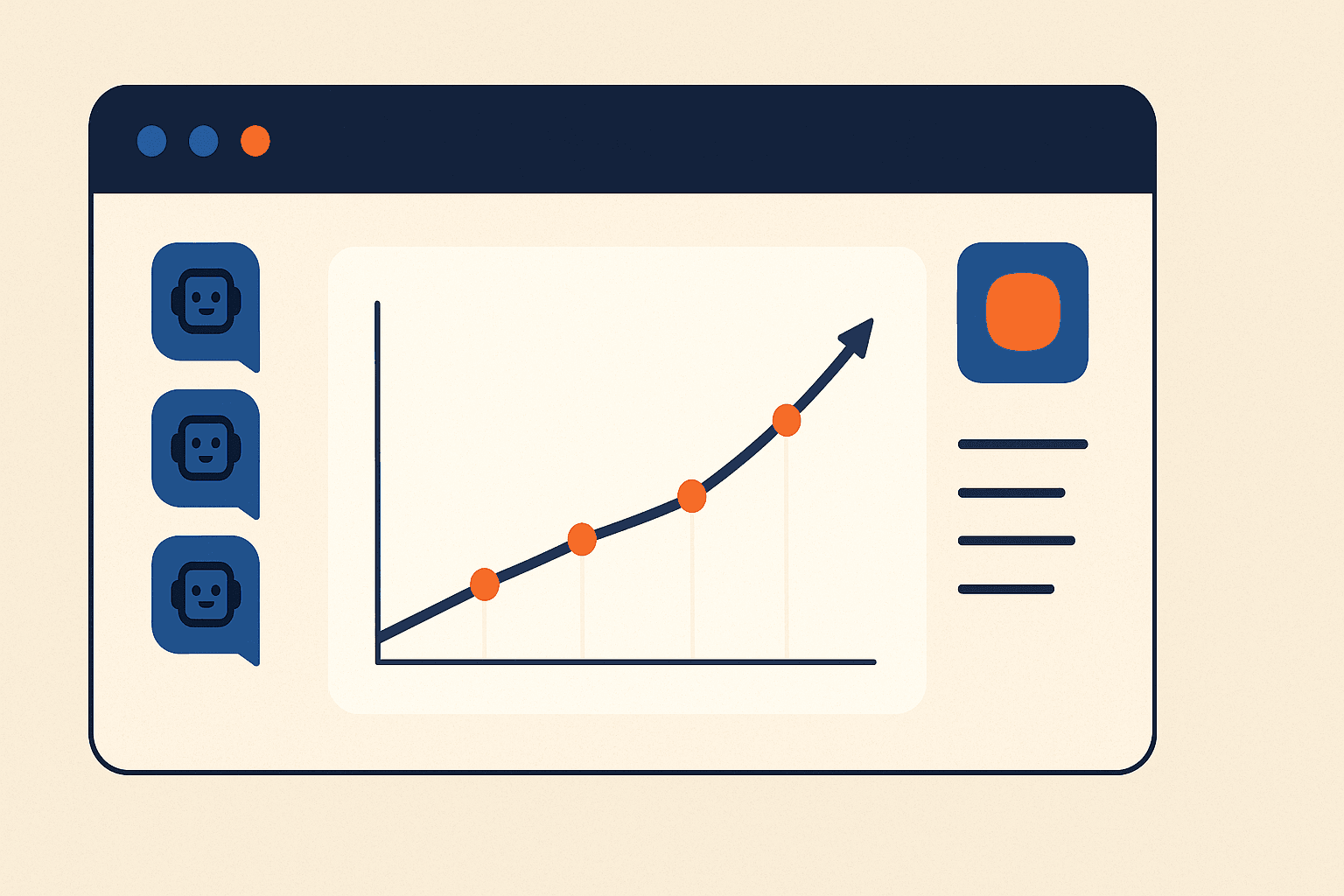
A snapshot is a curiosity; a time series is a metric. Re-run the same set weekly or monthly, alert on drops (falling out of a high-intent query is the AI-era equivalent of losing a top keyword ranking), and annotate changes - content you shipped, competitors' launches, model updates - so movements are explainable rather than mysterious.
A one-off run of this method is what an AI app visibility checker does; the scheduled version is AI recommendation tracking. Appeak Pro's free audit is the checker - paste your store URL and get your baseline - and its paid tier runs the tracking continuously.
What moves the number
Visibility is an output. The inputs are the signals assistants assemble answers from, and they are the subject of generative engine optimization for apps: a clean entity foundation the model can resolve (canonical entity page, Organization and SoftwareApplication structured data, AI crawlers allowed in robots.txt), answer-first content targeting the exact prompts in your query set, and - weightiest of all - independent third-party mentions that describe your app consistently. The full step-by-step sequence lives in our AI search optimization for apps guide.
Two practical notes from running this at scale. First, live-search-backed answers move fastest: a well-targeted answer-first page can enter ChatGPT's search-grounded responses within weeks, while training-data effects take model-update cycles. Second, description accuracy usually improves before appearance rate does - assistants start getting your facts right, then start naming you more. Watch for that ordering; it tells you the entity work is landing.
Tracking the traffic it sends
Close the loop in analytics. ChatGPT tags its outbound clicks with utm_source=chatgpt.com, so segment that source separately and watch it alongside your visibility numbers. Rising share of voice with flat referral traffic usually means you are appearing on low-intent queries; the fix is re-weighting your query set toward prompts with install intent.
Start with your baseline
You cannot manage what you have not measured, and most teams are surprised by their baseline - in both directions. Run the free AI visibility audit, see how ChatGPT, Gemini, and Claude treat your app today, and decide from evidence whether AI app visibility is a gap or an edge for you.
Frequently asked questions
What is AI app visibility?
AI app visibility is how often, and how favorably, AI assistants like ChatGPT, Gemini, and Claude surface your app when users ask for recommendations. It is measured across real user prompts: whether your app appears, where it ranks in the answer, how it is described, and its share of voice against competitors.
What is an AI app visibility checker?
An AI app visibility checker runs real recommendation prompts against AI assistants and reports whether your app shows up and how it is described. One-off checkers give you a snapshot; visibility tracking re-runs the same query set on a schedule so you can see movement, drops, and competitor changes over time.
What is share of voice in AI recommendations?
Share of voice is the percentage of relevant AI answers that include your app, measured against the total mentions across you and your competitors on the same query set. It is the single best summary metric for AI app visibility because it captures both your presence and the competitive context.
How is AI app visibility different from App Store ranking?
Store ranking is your position in a search results list inside the App Store or Google Play, driven by the store's algorithm. AI app visibility is your presence in the conversational shortlists assistants give, driven by your web footprint, structured data, and third-party corroboration. An app can rank well in the store and be invisible to AI, and vice versa.
How do I improve AI app visibility?
Improve the signals assistants build answers from: a clear entity foundation (canonical entity page, Organization and SoftwareApplication schema, AI crawlers allowed), answer-first content targeting the prompts users ask, and consistent third-party mentions. This is the GEO-for-apps framework; visibility tracking tells you whether it is working.
Side by side
Building your own AI ASO vs Appeak Pro
Rolling your own AI ASO pipeline (LLM prompts + scrapers + scoring + guardrails + UI) is a multi-quarter engineering project. Appeak Pro is the production version, already tuned to the actual store algorithms.
Build-your-own AI pipeline
- Cost
- 1-2 engineers + LLM credits
- Time to production
- 1-2 quarters of build, ongoing maintenance
- Coverage
- What you have time to build, usually keyword expansion only
Generic LLM (ChatGPT / Claude) prompted manually
- Cost
- Subscription only
- Time to production
- Same day
- Coverage
- Generic suggestions: no store data, no scoring, no guardrails
Appeak Pro
- Cost
- Flat subscription, no eng cost
- Time to production
- Minutes per audit
- Coverage
- Keywords + metadata + creative direction with store-policy guardrails baked in
Appeak Pro is the production AI ASO engine. No pipeline to build, no maintenance, no prompts to engineer.